Size controls colour
Colloidal quantum dots can convert blue light into narrow-band red or green emission. Display technology puts this size-dependent physics to work.
Semiconductor nanostructures
From colour conversion in modern displays to single-photon emitters and atomistic quantum-dot molecules.
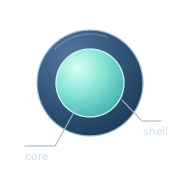
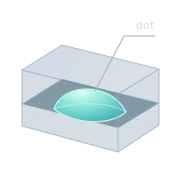
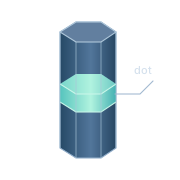
Representative geometries · not to scale. Nanowire dots can also be grown epitaxially.
Confining electrons and holes on the nanometre scale turns geometry, composition and atomic arrangement into design parameters.
Colloidal quantum dots can convert blue light into narrow-band red or green emission. Display technology puts this size-dependent physics to work.
A single dot can emit light one photon at a time. Its exciton states and their symmetry determine which optical transitions are possible.
Strain, interfaces and alloy disorder can change the ordering, splitting and brightness of exciton states, even in nominally similar dots.
Quantum dots are already in consumer electronics. In televisions, their role is colour conversion. In quantum photonics, an individual dot provides discrete optical transitions. The shared confinement physics does not make these the same device.
QLED LCD and QD-OLED displays use colloidal nanocrystals. Epitaxial and nanowire dots offer a different route to engineered quantum light.
My work connects atomic structure with optical spectra: from the character of a confined hole to the interactions between excitons. Tight-binding and configuration-interaction calculations underpin these studies; parallel algorithms and machine learning extend their reach.
Tall nanowire dots can host light-hole excitons. In self-assembled dots, reduced symmetry and alloy disorder can give nominally dark excitons measurable optical activity.
Interdot coupling allows electric-field control of exciton fine structure. Even a single crystal-phase dot can support an unusual antibonding hole ground state.
Strain can reshape wave functions and shift emission energies. Work with experimental collaborators connected a dielectric envelope around a nanowire to controlled optical tuning.
Algorithms developed with Piotr Różański make large-scale excitonic calculations practical. Coulombo and Coulombo-Lattice provide published implementations for Coulomb matrix elements.
Neural networks and transfer learning predict single-particle ground-state energies for double nanowire dots, reducing the number of atomistic calculations needed across a structural search space.
Studies with Agnieszka Gajewicz-Skretna examine how composition, surface termination and strain change carrier confinement and emission in cadmium-free core/shell nanocrystals.
I am a theoretical and computational physicist working on semiconductor nanostructures. I develop atomistic and many-body models of quantum dots, nanowires and nanocrystals, and work with experimental groups to connect those models with measured spectra.
Quantumdots.pl is my independent scientific website.
For questions about the research or potential modelling collaborations:
mzielin@fizyka.umk.pl